Many puzzle apps label their Sudoku difficulties "Easy", "Medium", "Hard", and "Expert" — but what do those labels actually mean? The answer is more precise than most players realise, and understanding it will help you choose the right challenge for your skill level and improve much faster.
The Myth of the Clue Count
A common assumption is that fewer given numbers = harder puzzle. It's a reasonable guess — but it's wrong as a general rule. A puzzle with 24 clues can be trivially easy if those clues are arranged to create immediate lone singles everywhere. A puzzle with 30 clues can be fiendishly hard if the clue placement requires advanced constraint logic to make any progress.
The number of clues does impose a minimum (a valid puzzle needs at least 17 givens to have a unique solution), but beyond that, clue placement and the techniques required determine difficulty far more than clue count.
How Difficulty Is Actually Measured
Professional Sudoku generators and graders — including the algorithm used in Sudoku Dark — rate difficulty by simulating a solver that uses techniques in order of increasing complexity. The difficulty of a puzzle equals the hardest technique needed to solve it without guessing.
This produces consistent, technique-based ratings:
| Level | Techniques Required | Typical Solve Time | Best For |
|---|---|---|---|
| Easy | Lone singles only — every cell can be filled with a direct elimination | 3–8 min | Complete beginners, warm-up |
| Medium | Lone singles + hidden singles; some scanning and crosshatching required | 8–20 min | Beginners building fluency |
| Hard | Naked pairs, hidden pairs, pointing pairs (locked candidates) | 15–40 min | Intermediate players |
| Expert | Naked/hidden triples, X-Wing, Swordfish, Y-Wing, or chains | 30 min – 2 hrs | Experienced solvers |
Important
A valid Sudoku puzzle always has exactly one solution. If you find yourself in a position where you must guess to continue — that's a sign the puzzle requires a technique you haven't applied yet, not that guessing is intended.
What Each Level Actually Demands
Easy
An Easy puzzle can be solved entirely by finding cells that have only one possible value. You don't need to track candidates or use any pattern recognition beyond scanning rows, columns, and boxes. The puzzle essentially solves itself if you're methodical. Easy puzzles are the ideal starting point for new players because they build scanning fluency and confidence.
Medium
Medium puzzles require hidden singles — situations where a digit can only go in one cell within a unit, even if that cell appears to have multiple options. This demands slightly more attention and the beginnings of systematic candidate thinking. Medium is where most casual players spend the most time, and where the foundational habit of using notes pays off most.
Hard
Hard puzzles require you to eliminate candidates using pairs and locked candidates. You'll hit a wall where no single cell can be determined in isolation — progress only comes from reasoning about groups of cells together. This is a meaningful jump in logical depth and is the first level where writing candidates is essentially mandatory. Many players who consider themselves "good at Sudoku" get stuck at this level because they haven't yet learned naked pairs.
Expert
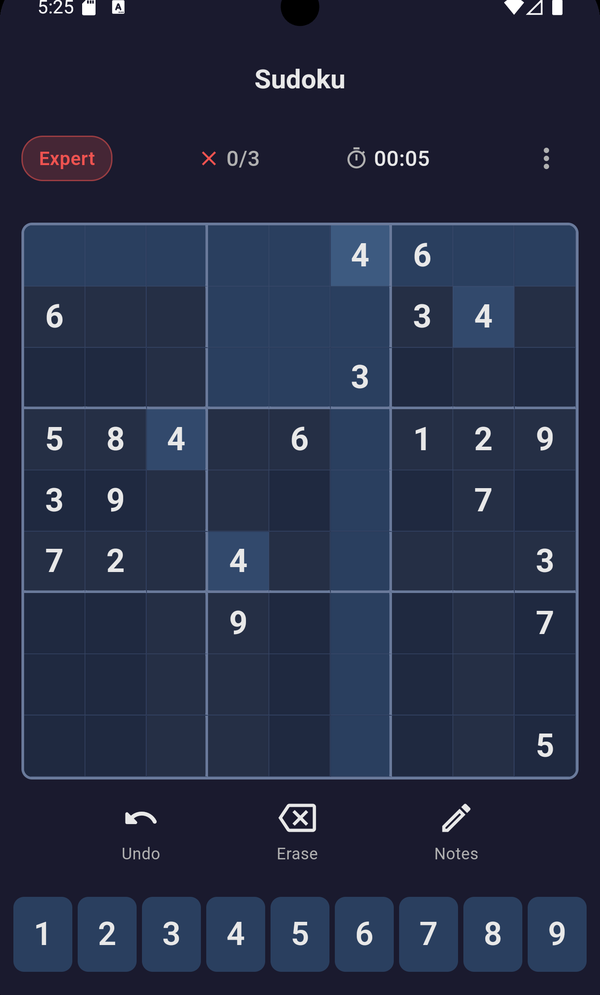
Expert puzzles require multi-unit logic: X-Wings, Swordfish, Y-Wings, or inference chains. These techniques involve patterns that span multiple rows and columns simultaneously. Solving an Expert puzzle correctly — without guessing — is a significant achievement. Expert solving is also much slower; even experienced solvers might spend 30–60 minutes on a single puzzle.
Why Puzzle Quality Matters Beyond Difficulty
Not all "Hard" puzzles are created equal. A well-designed Hard puzzle has a smooth solving path — each technique opens up new information that leads naturally to the next step. A poorly designed Hard puzzle might require obscure or debated techniques, or have multiple technique "dead ends" that frustrate rather than challenge.
Sudoku Dark uses a generator that validates each puzzle against a multi-technique solver and ensures a clean, unambiguous solve path at the intended difficulty level. Every puzzle has exactly one solution and can be solved without guessing.
Choosing the Right Level for You
The right difficulty is one where you occasionally get stuck, but not for too long. A rough guide:
- Never played before: Start on Easy. Spend at least a few sessions there.
- Can solve Easy quickly: Move to Medium. Focus on learning hidden singles.
- Comfortable with Medium: Try Hard, and commit to using notes. Learn naked pairs.
- Can finish Hard puzzles: Try Expert. Read about X-Wings and advanced techniques.
The biggest mistake players make is staying at a comfortable level indefinitely. The cognitive benefits of Sudoku — and the enjoyment — come from being stretched, not from breezing through familiar patterns.
Find Your Level
Sudoku Dark offers Easy, Medium, Hard, and Expert puzzles. Jump in at any level and challenge yourself to progress — your best times and stats are tracked automatically.
Play Sudoku Dark — Free