Sudoku is one of the most popular puzzles in the world — and it's also one of the most misunderstood. Many beginners assume you need to be good at maths, or that solving a puzzle requires guessing. Neither is true. Sudoku is a pure logic puzzle. Every number in every cell can be determined through reasoning alone, and this guide will teach you exactly how to do that.
1. The Rules in 60 Seconds
A standard Sudoku puzzle uses a 9×9 grid divided into nine 3×3 boxes. Some cells are pre-filled with numbers (called "givens" or "clues"). Your job is to fill every empty cell so that:
- Every row contains the numbers 1–9 with no repeats
- Every column contains the numbers 1–9 with no repeats
- Every 3×3 box contains the numbers 1–9 with no repeats
That's it. No maths, no addition — just unique placement. Each completed puzzle has exactly one valid solution.
 ╔═══╤═══╤═══╦═══╤═══╤═══╦═══╤═══╤═══╗
 ║ 5 │ 3 │ · ║ · │ 7 │ · ║ · │ · │ · ║
 ║ 6 │ · │ · ║ 1 │ 9 │ 5 ║ · │ · │ · ║
 ║ · │ 9 │ 8 ║ · │ · │ · ║ · │ 6 │ · ║
 ╠═══╪═══╪═══╬═══╪═══╪═══╬═══╪═══╪═══╣
 ║ 8 │ · │ · ║ · │ 6 │ · ║ · │ · │ 3 ║
 ║ 4 │ · │ · ║ 8 │ · │ 3 ║ · │ · │ 1 ║
 ║ 7 │ · │ · ║ · │ 2 │ · ║ · │ · │ 6 ║
 ╠═══╪═══╪═══╬═══╪═══╪═══╬═══╪═══╪═══╣
 ║ · │ 6 │ · ║ · │ · │ · ║ 2 │ 8 │ · ║
 ║ · │ · │ · ║ 4 │ 1 │ 9 ║ · │ · │ 5 ║
 ║ · │ · │ · ║ · │ 8 │ · ║ · │ 7 │ 9 ║
 ╚═══╧═══╧═══╩═══╧═══╧═══╩═══╧═══╧═══╝
A classic beginner-friendly Sudoku grid. The "·" marks are empty cells you need to fill.
2. How to Approach Your First Puzzle
The most common beginner mistake is to stare at the whole grid at once. Instead, break the problem down into small, answerable questions.
Step 1: Look for Rows, Columns, or Boxes That Are Almost Full
If a row already contains eight numbers, the missing one is trivial to find. Start with the cells that have the most constraints — the fewer possibilities a cell has, the easier it is to fill.
Step 2: Use Scanning (Row-Column Elimination)
Pick a number, say 7, and ask: "Where can 7 go in this box?" Look at every row and column that passes through the box. Any row or column that already contains a 7 eliminates the corresponding cells in that box. If only one cell in the box is left, that cell must be 7.
Step 3: Use Crosshatching
Crosshatching is scanning applied to a single digit across the entire grid. Look at all 9 cells where a particular digit could go in a band of three boxes. Use the givens in neighbouring rows and columns to eliminate cells until only one possibility remains in each box.
Pro Tip
Work through the numbers 1–9 one at a time when you're starting out. For each number, use scanning to place it in as many cells as you can before moving on.
3. The Lone Single: The Most Common Beginner Solve
A lone single (also called a "naked single") is a cell that can only contain one possible number. Every other digit 1–9 is already present in that cell's row, column, or box. When you find one, fill it in immediately.
To find lone singles efficiently:
- Look at an empty cell.
- Check its row — which numbers are already there?
- Check its column — eliminate those too.
- Check its 3×3 box — eliminate those.
- If only one number 1–9 is not eliminated, write it in.
On beginner-level puzzles, repeating this process for every empty cell is often enough to solve the entire puzzle.
4. The Hidden Single: One Step Beyond
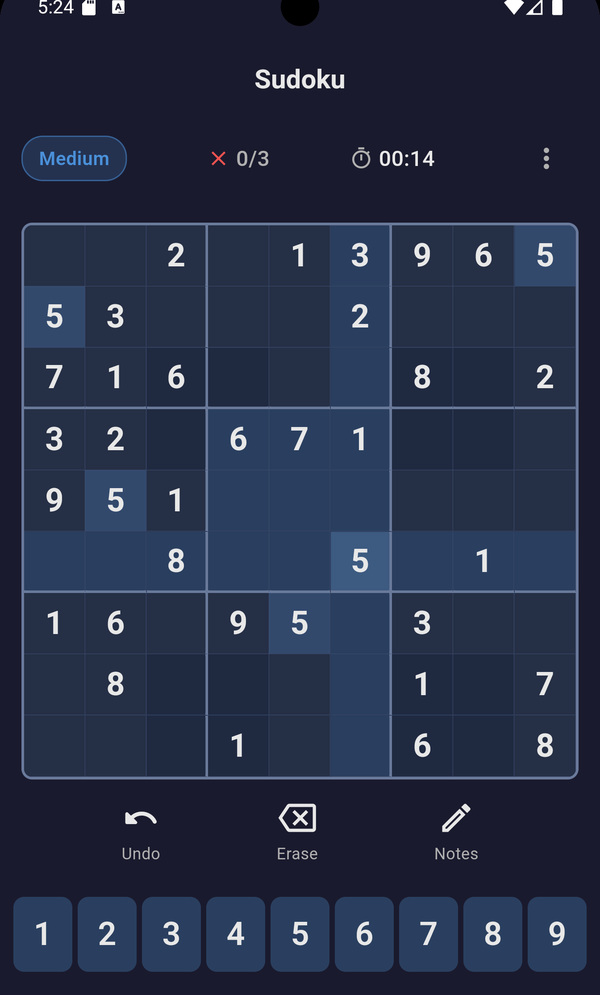
A hidden single occurs when a particular digit can only go in one cell within a row, column, or box — even if that cell appears to have multiple possibilities.
For example: suppose in the top-right 3×3 box, only one cell can contain the number 4 (because every other cell in the box is blocked by a 4 somewhere in its row or column). Even if that cell could also theoretically hold a 3, 5, or 8, you know it must be 4. That's a hidden single.
Remember
You don't need to know exactly what all other values in a cell are. You just need to prove that one particular value must go there.
5. Using Pencil Marks (Notes)
When a cell has more than one possible value and you can't yet determine which one it is, write all the candidates in the cell as small notes. These are called pencil marks or candidates.
Pencil marks let you:
- See the full picture of what's possible across the grid
- Spot patterns that lead to advanced techniques
- Avoid making a mistake from trying to hold everything in your head
In Sudoku Dark, tap the pencil icon to toggle note mode. When you later fill in a number, the app automatically clears conflicting notes for you.
6. Common Beginner Mistakes to Avoid
Guessing Too Early
Guessing introduces risk: a wrong guess can cascade into errors that take ten minutes to undo. Always try to find a logical reason for every number you place.
Ignoring One of the Three Constraints
Always check all three: row, column, and box. Beginners often focus on rows and columns but forget to check whether the 3×3 box already contains the number they're about to write.
Writing Numbers in Too Fast
When you're learning, slow down. Double-check each placement before moving on. Speed comes naturally with practice.
7. Building a Solving Routine
Good Sudoku solvers don't just react to individual cells — they follow a systematic sweep. Here's a reliable routine for beginners:
- First pass: Scan for any rows, columns, or boxes with 7 or more filled cells. Fill any obvious lone singles.
- Number sweep: Pick each digit 1–9. Use scanning and crosshatching to place it wherever you can.
- Hidden singles pass: For each unsolved box, check if any digit can only go in one remaining cell.
- Pencil marks: Once the easy cells are done, write candidates in every remaining empty cell.
- Repeat: After filling in each new number, update affected cells and return to step 1.
8. What Comes Next?
Once scanning, crosshatching, lone singles, and hidden singles feel natural, you're ready for intermediate techniques. Mastering pencil marks is the bridge between beginner and intermediate — they unlock patterns you simply can't see without them.
When you're ready for a real challenge, advanced strategies like naked pairs and X-Wings are the next step. These techniques allow you to solve the hardest puzzles in the world without guessing a single digit.
Ready to Put This Into Practice?
Sudoku Dark has puzzles at every difficulty level — from Gentle to Expert — with automatic hint highlighting and note-taking built right in. It's free and works right in your browser.
Play Sudoku Dark — Free