Every Sudoku app labels its puzzles Easy, Medium, Hard, and Expert, but almost none of them explain what those words mean. Players notice the inconsistency immediately: a "Hard" puzzle in one app feels like another app's "Medium", and an app's "Expert" sometimes turns out to be trivially easy once you spot one lucky opening.
Having built the generator behind Sudoku Dark, I want to explain how difficulty is actually determined — and why the most intuitive measure, the number of blank cells, turns out to be almost useless.
Why Clue Count Is a Bad Difficulty Measure
The obvious idea is that fewer given numbers means a harder puzzle. It's partly true, and it's the reason most apps show a clue count. But it breaks down fast.
The minimum number of clues a valid Sudoku can have is 17. That was an open question for years until a 2012 exhaustive computer search by Gary McGuire, Bastian Tugemann and Gilles Civario confirmed no 16-clue puzzle with a unique solution exists. Yet plenty of 17-clue puzzles are solvable with nothing but scanning, while some 30-clue puzzles require chain logic that will stop most players cold.
The reason is that where the clues sit matters far more than how many there are. Twenty-four clues spread evenly across all nine boxes constrain the grid very differently from twenty-four clues bunched into three boxes. Clue count is a weak proxy for a much better question: what do you have to do to make progress?
Difficulty Is the Hardest Technique You Are Forced to Use
The measure that actually works is technique depth. Solving techniques form a rough hierarchy, from mechanical to genuinely demanding:
| Tier | Technique | What it asks of you |
|---|---|---|
| 1 | Lone single | One cell in a unit is empty. Fill it. |
| 2 | Hidden single (scanning) | A digit fits in only one cell of a box, row or column. |
| 3 | Naked / hidden pairs | Two cells lock two candidates between them. |
| 4 | Pointing pairs, box-line reduction | Candidates confined to a line inside a box. |
| 5 | X-Wing, Swordfish | Rectangular candidate patterns across two or three units. |
| 6 | Forcing chains, XY-Wing | Multi-step implication chains held in memory. |
A puzzle's rating is the highest tier it forces you to reach. If a grid can be finished entirely with tiers 1 and 2, it is Easy no matter how many blanks it started with. If there is a point where every simpler technique stalls and only an X-Wing unlocks the next cell, it is Expert — even if it started with thirty clues.
How a Puzzle Actually Gets Made
Generation runs backwards from what you might expect. You do not build a puzzle and then find its solution — you build a solution and then carve a puzzle out of it.
Step 1: Build a complete, valid grid
Fill an empty 9×9 grid with a backtracking algorithm: place a legal digit in the first empty cell, move on, and when you hit a contradiction, back up and try the next candidate. Randomising the order in which digits are tried makes each run produce a different grid. There are 6,670,903,752,021,072,936,960 valid complete Sudoku grids, so repeats are not a concern.
Step 2: Remove clues, one at a time, checking as you go
This is the part that matters. Pick a filled cell, empty it, and then re-solve the whole grid counting solutions. If exactly one solution remains, the removal is safe and you keep it. If two or more solutions appear, the puzzle has become ambiguous — put the digit back and try a different cell.
This uniqueness check is the single most important step in the whole process, and it is where cheaply-made puzzles fail. A puzzle with two solutions cannot be solved by logic alone — at some point you must guess, and both branches will be internally consistent. Nothing feels worse than filling a grid correctly and being told it is wrong. Every Sudoku Dark puzzle is verified to have exactly one solution before it is ever served.
Step 3: Rate what you ended up with
Once removal stops, the puzzle is run through a solver that only knows the tiered technique list above. It applies tier 1 repeatedly, then tier 2, and only escalates when nothing simpler makes progress, recording the deepest tier it needed. That recorded depth is the difficulty label. If the puzzle came out harder or easier than the level being generated, it is discarded and the process repeats.
Why "no guessing" is a real guarantee
Because the rating solver only uses logical techniques and never guesses, a puzzle that receives a rating is by definition solvable without guessing. If the technique solver cannot finish a grid, that grid never ships — regardless of how attractive its clue count looks.
What Makes an Expert Puzzle Feel Expert
Three properties, none of which is "lots of blanks":
- Long dependency chains. Filling a cell unlocks only one more cell rather than cascading through the grid, so progress stays slow throughout.
- Late bottlenecks. The puzzle gives you an easy opening and then stalls at around 40 cells filled, exactly when you have stopped concentrating.
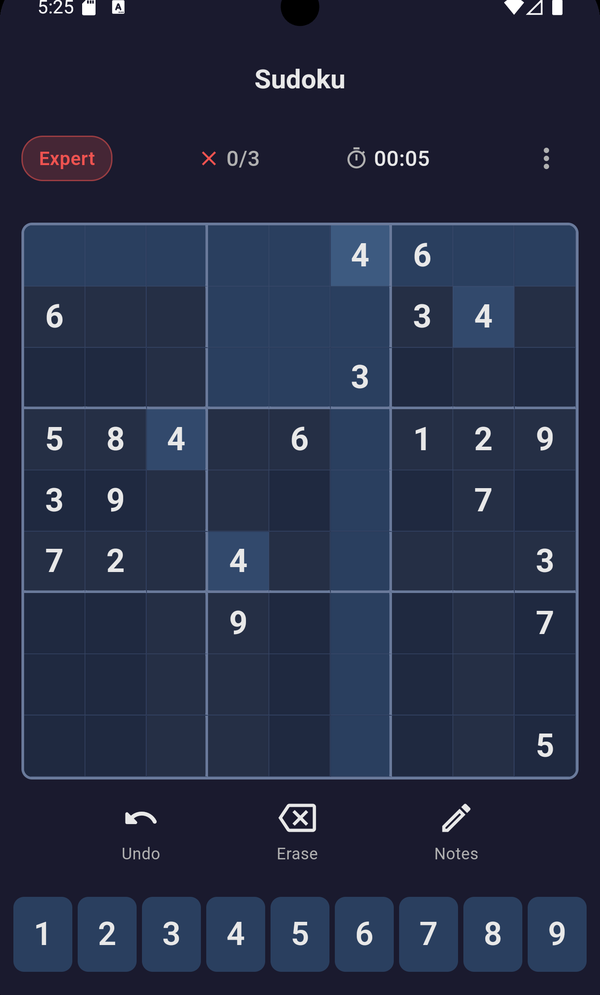
- Sparse boxes. One or two boxes carry very few clues, so they cannot be attacked directly and must be resolved indirectly through their intersecting rows and columns.
You can see all three properties at work in an Expert grid, where the visible clues cluster and whole regions are left to be resolved indirectly:
Is Difficulty Objective?
Partly. Technique depth is objective and reproducible: two solvers implementing the same tier list will rate a puzzle identically. What is not objective is how hard a given technique feels to a given person. A player who has drilled X-Wings will breeze through a puzzle that stops someone who has never seen the pattern, even though the pattern is objectively tier 5 for both of them.
That is why difficulty labels are best treated as a description of what a puzzle will ask of you, not a prediction of how long you will take. If Expert puzzles feel impossible, it is usually not raw ability — it is that one specific technique has not clicked yet. Our advanced strategies guide walks through the tier-5 patterns directly.
See the Difference for Yourself
Play the same technique tiers back to back. Sudoku Dark offers Easy, Medium, Hard, and Expert puzzles — every one generated, uniqueness-checked, and rated by the process described above.
Play a Rated Puzzle — Free